

Over 100 nationalities can visit South Korea visa-free, but most still need a K-ETA (Korea Electronic Travel Authorization) before boarding their flight. The full list includes citizens of the United States, the United Kingdom, Canada, Australia, Japan, and all visa-exempt European, Asian, and Latin American countries. K-ETA costs just 10,000 KRW (~$7-8 USD) and is processed within 72 hours, though it is temporarily exempt through December 31, 2026, and will become mandatory again on January 1, 2027.
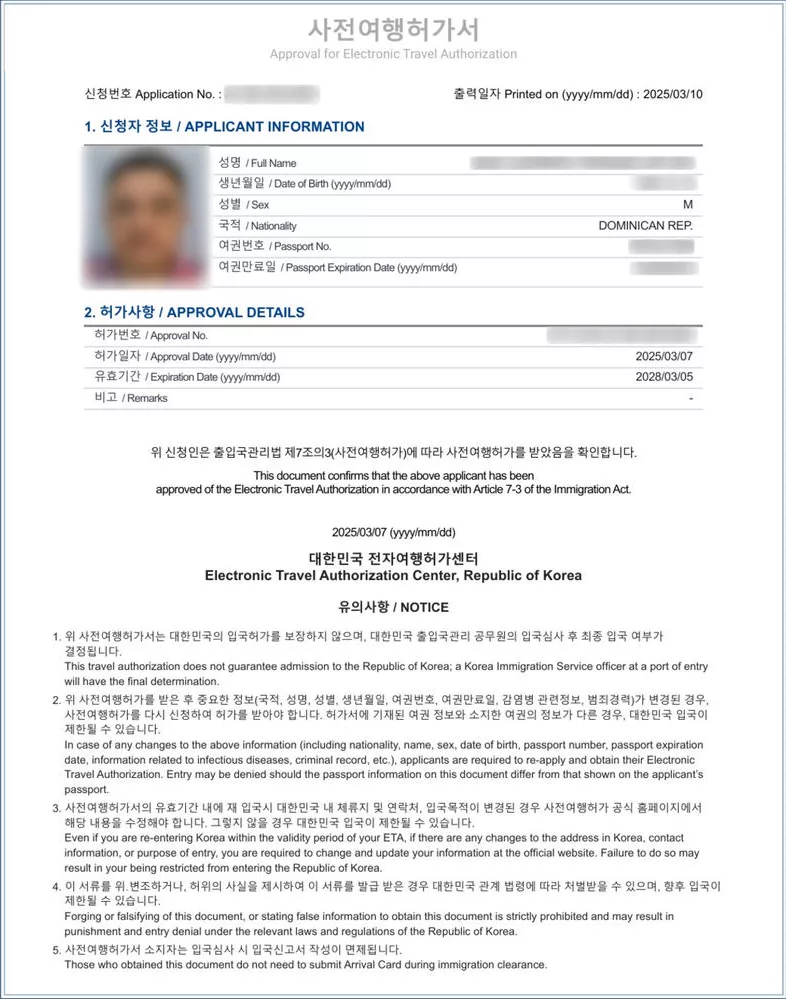
What Is K-ETA and Who Needs It?
K-ETA stands for Korea Electronic Travel Authorization. It is a pre-travel screening system that citizens of visa-exempt countries must complete before entering South Korea. Rather than obtaining a full visa at a Korean embassy, eligible travelers fill out an online application that takes roughly 10 minutes and costs 10,000 KRW (approximately $7-8 USD).
The key rule is simple: if your nationality allows visa-free entry to South Korea, you need K-ETA. If you already require a traditional visa, K-ETA does not apply to you – you must apply for a visa at a Korean embassy or consulate instead.
For a full overview of the system, see our What Is K-ETA? guide.
Complete List of K-ETA Required Countries
Below is the full list of nationalities that require K-ETA to enter South Korea. These are the countries whose citizens enjoy visa-free access but must obtain K-ETA approval before traveling.
Americas
| Country | Region |
|---|---|
| Antigua and Barbuda | Caribbean |
| Argentina | South America |
| Bahamas | Caribbean |
| Barbados | Caribbean |
| Brazil | South America |
| Canada | North America |
| Chile | South America |
| Colombia | South America |
| Costa Rica | Central America |
| Dominica | Caribbean |
| Dominican Republic | Caribbean |
| Ecuador | South America |
| El Salvador | Central America |
| Grenada | Caribbean |
| Guatemala | Central America |
| Haiti | Caribbean |
| Honduras | Central America |
| Jamaica | Caribbean |
| Mexico | North America |
| Nicaragua | Central America |
| Panama | Central America |
| Paraguay | South America |
| Peru | South America |
| Saint Kitts and Nevis | Caribbean |
| Saint Lucia | Caribbean |
| Saint Vincent and the Grenadines | Caribbean |
| Suriname | South America |
| Trinidad and Tobago | Caribbean |
| United States | North America |
| Uruguay | South America |
| Venezuela | South America |
Europe
| Country | Region |
|---|---|
| Albania | Southeast Europe |
| Andorra | Western Europe |
| Austria | Western Europe |
| Belgium | Western Europe |
| Bosnia and Herzegovina | Southeast Europe |
| Bulgaria | Eastern Europe |
| Croatia | Southeast Europe |
| Cyprus | Southern Europe |
| Czech Republic | Central Europe |
| Denmark | Northern Europe |
| Estonia | Northern Europe |
| Finland | Northern Europe |
| France | Western Europe |
| Germany | Western Europe |
| Greece | Southern Europe |
| Hungary | Central Europe |
| Iceland | Northern Europe |
| Ireland | Western Europe |
| Italy | Western Europe |
| Latvia | Northern Europe |
| Liechtenstein | Western Europe |
| Lithuania | Northern Europe |
| Luxembourg | Western Europe |
| Malta | Southern Europe |
| Monaco | Western Europe |
| Montenegro | Southeast Europe |
| Netherlands | Western Europe |
| North Macedonia | Southeast Europe |
| Norway | Northern Europe |
| Poland | Central Europe |
| Portugal | Southern Europe |
| Romania | Eastern Europe |
| San Marino | Southern Europe |
| Serbia | Southeast Europe |
| Slovakia | Central Europe |
| Slovenia | Central Europe |
| Spain | Southern Europe |
| Sweden | Northern Europe |
| Switzerland | Western Europe |
| Turkey | Southeast Europe/Asia |
| Ukraine | Eastern Europe |
| United Kingdom | Western Europe |
| Vatican City | Southern Europe |
Asia and Oceania
| Country | Region |
|---|---|
| Australia | Oceania |
| Bahrain | Middle East |
| Brunei | Southeast Asia |
| Fiji | Oceania |
| Guam (US territory) | Pacific |
| Hong Kong SAR | East Asia |
| Israel | Middle East |
| Japan | East Asia |
| Kazakhstan | Central Asia |
| Kiribati | Pacific |
| Kuwait | Middle East |
| Macao SAR | East Asia |
| Malaysia | Southeast Asia |
| Marshall Islands | Pacific |
| Mauritius | Africa/Indian Ocean |
| Micronesia | Pacific |
| Morocco | North Africa |
| Nauru | Pacific |
| New Caledonia (France) | Pacific |
| New Zealand | Oceania |
| Oman | Middle East |
| Palau | Pacific |
| Qatar | Middle East |
| Russia | Eastern Europe/Northern Asia |
| Samoa | Pacific |
| Saudi Arabia | Middle East |
| Seychelles | Africa/Indian Ocean |
| Singapore | Southeast Asia |
| Solomon Islands | Pacific |
| South Africa | Africa |
| Taiwan | East Asia |
| Thailand | Southeast Asia |
| Tonga | Pacific |
| Tunisia | North Africa |
| Tuvalu | Pacific |
| United Arab Emirates | Middle East |
K-ETA Temporary Exemption in 2026
As of 2026, there is a significant exception to the K-ETA requirement. K-ETA is temporarily exempt through December 31, 2026. This means travelers from countries listed above can enter South Korea without applying for K-ETA during this exemption period.
Key points about the exemption:
- The exemption was extended multiple times since its initial announcement
- K-ETA will become mandatory again on January 1, 2027 for all listed nationalities
- You can still voluntarily apply for K-ETA during the exemption period – having a valid K-ETA may speed up immigration processing
- The exemption applies to normal tourist and short-term visits only; other entry categories may have separate requirements
Check the official K-ETA website for the latest exemption updates, as dates can change.
For the most up-to-date status, see our Is K-ETA Still Required in 2026? page.
Countries That Do NOT Need K-ETA
Not every traveler heading to South Korea needs K-ETA. The following groups are exempt from K-ETA regardless of any temporary waiver:
- Citizens who require a traditional visa. If your country is not on the visa-exempt list, you need a regular visa from a Korean embassy or consulate. K-ETA does not replace a visa.
- South Korean nationals and residents. Korean citizens (including dual nationals entering on a Korean passport) and valid residence card holders do not need K-ETA.
- APEC Business Travel Card holders. If you hold a valid ABTC endorsed for Korea, you can enter without K-ETA for business purposes.
- Transit passengers. Travelers who are transiting through a Korean airport and remaining in the international transit area typically do not need K-ETA.
- Diplomatic and official passport holders. Citizens of many countries may enter visa-free on diplomatic or official passports, which are separate from regular passport K-ETA rules.
- Jeju Island visitors. Travelers arriving directly at Jeju Island under the Jeju Visa Waiver Program can visit for up to 30 days without K-ETA.
For a detailed comparison, see our K-ETA vs South Korea Visa guide.
How K-ETA Works for Different Regions
Americas
Citizens of Canada, the United States, Mexico, Brazil, Argentina, Colombia, and most other American nations fall under the K-ETA requirement. Canadians and Americans are among the most frequent applicants. If you are a US, Canadian, or Latin American passport holder, you apply the same way through the official K-ETA app or website. See our specific guides for US citizens and Canadian citizens.
Europe
All 27 European Union member states plus the United Kingdom, Switzerland, Norway, Iceland, and several other European nations are on the list. UK citizens represent one of the largest groups of K-ETA applicants. Read our K-ETA for UK Citizens page for British-specific guidance. Note that while most EU countries are included, holders of certain lesser-traveled European passports should verify their eligibility.
Asia and Pacific
Japan, Singapore, Australia, New Zealand, Hong Kong, Taiwan, Thailand, and Malaysia are among the key Asian and Pacific countries requiring K-ETA. Australian citizens have additional guidance available on our K-ETA for Australian Citizens page. Russian citizens also require K-ETA for visa-free entry.
Middle East and Africa
Several Gulf states are on the list including Bahrain, Kuwait, Oman, Qatar, Saudi Arabia, and the United Arab Emirates. Morocco, Tunisia, South Africa, and Mauritius are the African nations included. Israel is also on the list.
How to Apply for K-ETA
The application process is straightforward and handled entirely online:
- Visit the official K-ETA website or download the K-ETA app
- Fill in your personal information and passport details
- Upload a photo matching your passport
- Answer health and security questions
- Pay the 10,000 KRW (~$7-8 USD) application fee
- Wait for approval – most applications are processed within 72 hours
After approval, your K-ETA is valid for 2 years (or until your passport expires, whichever comes first). You can enter South Korea multiple times during the validity period without reapplying.
For a step-by-step walkthrough, see our How to Apply for K-ETA guide.
What Happens If Your K-ETA Is Rejected?
K-ETA approval is not guaranteed. Applications can be denied for various reasons including incomplete information, previous immigration violations, or security flags. If your application is denied, you can reapply with corrected information or apply for a traditional visa at a Korean embassy.
For full details on the rejection reasons and reapplication process, see K-ETA Denied: What to Do If Rejected.
FAQs About K-ETA Required Countries
Do Indian citizens need K-ETA for South Korea?
No. Indian passport holders are not on the K-ETA required countries list because India does not have a visa-exemption agreement with South Korea. Indian citizens must apply for a traditional South Korea visa at a Korean embassy or consulate. See K-ETA for Indian Citizens for more details.
Do Chinese citizens need K-ETA?
No. Chinese passport holders are not eligible for K-ETA because China is not on South Korea’s visa-exempt list. Chinese citizens need to apply for a regular visa. There are limited exceptions for group tours and specific transit programs.
Can I enter South Korea without K-ETA in 2026?
Yes, temporarily. K-ETA is exempt through December 31, 2026, for all eligible nationalities. However, when the exemption ends on January 1, 2027, K-ETA will be mandatory again. We recommend applying in advance so you are ready when the requirement returns.
Is K-ETA the same as a South Korea visa?
No. K-ETA is an electronic travel authorization for citizens of visa-exempt countries. It is simpler, cheaper ($7-8), and faster (within 72 hours) than a traditional visa. If you are not from a visa-exempt country, you need a full visa from a Korean embassy. See K-ETA vs Visa for a full comparison.
How many countries need K-ETA?
Over 100 countries and territories require K-ETA for visa-free entry to South Korea. This includes all major Western nations, most of Asia, and select countries from every region. The exact number can change as South Korea updates its visa-exemption agreements.
Do I need K-ETA if I have a Korean residence card?
No. Holders of valid Korean Alien Registration Cards (ARC) or residence permits do not need K-ETA. K-ETA is only required for short-term visitors entering under visa-exempt arrangements.
Does my K-ETA cover multiple entries?
Yes. A single approved K-ETA is valid for 2 years (or until your passport expires) and allows multiple entries to South Korea. You do not need to reapply each time you visit.
Do I need K-ETA for Jeju Island only?
No. If you are flying directly to Jeju Island and staying only on the island, the Jeju Visa Waiver Program allows up to 30 days of stay without K-ETA or a visa. However, if you plan to visit mainland South Korea as well, K-ETA rules apply normally.